A brief examination of Tibet's History and its claim to independence.

_____________________
The price of Freedom is Eternal Vigilance -
and sometimes your Life!
_______________________________
Tibetans are a uniquely distinct Race, different from all the surrounding Peoples.
 Tibetan Girl
They inhabited their own Territory for many Millennia as a cohesive and homogeneous Race.
Tibet’s recorded History stretches as far back as 127 BC.
As with all great Nations on this planet, the interactions with its neighbours was numerous; sometimes violent, often they prevailed over their adversaries, and at times proved less successful.
Between the seventh and ninth centuries, the Tibetan Nation often defeated the T'ang dynasty in the many battles fought during this era.

In 641 The T'ang emperor Taizong, 太宗, (貞觀) ceded Princess Wen Cheng plus a dowry of large quantities of gold and other treasures to King Songtsen Gampo of the Tibetan Yarlung Dynasty, which he demanded after the Tibetan army occupied large swathes of Chinese territories, and in an attempt to avert certain defeat at the hands of the Tibetans.
In 763, under the Tibetan ruler Trisong Detsän (Detsen), the Tibetan army captured Chang’an, the T'ang Dynasty’s capital and extracted a hefty tribute of 50,000 bolts of silk, plus an annual tax to the victorious Tibetans. The Tibetans installed a puppet prince who signed an agreement to fulfil this annual tribute; however he didn’t last too long on the throne after the departure of the Tibetan army.
During the era, 663 to 692, the Tibetans occupied vast swathes of T'ang Dynasty territories in the Tarim Basin, Dzungaria, Xinjiang, Qinghai and Gansu.
In 821 Tibet, under Ralpacan, and T'ang Dynasty under the Ruler Hwang Te entered into a Treaty as independent Nations.
The T'ang Dynasty had made many pacts and signed peace treaties with Tibet before, of which none lasted too long, until the powerful Tibetans clearly threatened the existence of the T'ang Empire and consequently this bilingual treaty was drafted and signed.
The Treaty in part reads:
"The two Nations, Tibet and China, shall keep the country and frontiers which they now possess. The whole region to the East of that being the country of Great China and the whole region to the West being assuredly the Country of GREAT TIBET, from either side there shall be no warfare, no hostile invasions, and no seizure of territory…………
And in order that this Agreement establishing a great era where Tibetans shall be happy in TIBET, and Chinese shall be happy in China shall NEVER be changed, the Three Jewels, the body of Saints, the sun and the moon, planets and stars have been invoked as witnesses." This Treaty was engraved on three stone pillars of which one is still standing in front of the Johkang Cathedral.
[see Footnotes: a]

During the 13th Century, China was conquered and subjugated by the Mongols, who established the Yuan Dynasty, and was ruled thereafter directly by Mongol rulers. 
The Mongols divided the Chinese territory into twelve provinces for administration, and Tibet was not one of these.
By contrast, Tibet entered into an Agreement (Cho-Yon) with the Mongols, pledging allegiance, and in turn became their Spiritual Advisors and Mutual Friends.
The importance of this relationship is expressed in the fact that Kublai Khan invited the Tibetan Sakya Lama to become the Protector and Religious Figurehead to his Empire.
Tibet was ruled by Tibetan Rulers during the Mongol Empire.
The Yuan Dynasty was evidently a Mongol Dynasty ruled by Mongols, and the last Mongol emperor Toghon Timur Kham, 孛兒只斤妥懽帖睦爾, was only driven out in 1368.
Tibet left the Mongol Empire in 1354, well prior to China, as it was always treated as a separate State, with Chang-chub Gyaltsen assuming and reorganising governance over Tibet.
[see Footnotes: b]
After the demise of the Mongol Empire, during the Ming Dynasty, Tibet had little close associations with any other nation for 300 years and, as always, conducted its own internal and external Affairs. 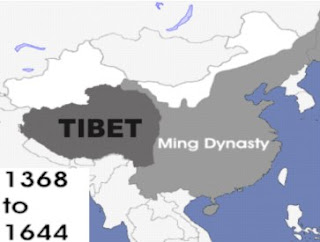
The first Ming Emperor Hung-wu, 洪武, referred to Tibet as a Foreign Nation in explicit and unequivocal terms.
As the Ming emperor perceived any threat to be primarily coming from the north, namely the Mongols they courted friendly relations with Tibet in order to eliminate any threat from the west.
They were very mindful of the T’ang dynasty years where Tibet posed such a powerful threat and occupied vast swathes of T’ang territories.
Hung-wu was a devout and ardent follower of Buddhism and in 1378 sent a Buddhist monk to Tibet to collect as many Buddhist texts and artefacts he could gather.
Ming Emperors bestowed some honorific titles to Tibetan Lamas and religious figure heads, which conferred nothing else than an honour bestowed to an esteemed and revered religious leader and did not influence the independence and succession of temporal Tibetan rulers, who exercised effective and sovereign power in Tibet.
Such exchange of titles was a contemporary practice between sovereign nations and merely conferred respect and honour to the recipient nation.
[see Footnotes: c]
The Ming Emperor Yongle, 永樂, invited several Tibetan religious leaders, some of which declined the invitation by this foreign ruler.
in 1403 Yongle dispatched his envoy Hou-shien with a letter of invitation to the Fifth Karmapa.
The Fifth Karmapa Dezhin Shekpa accepted the invitation, and in 1407 in an extraordinary display of deference, Yongle travelled a fair distance out of his palace and town to greet the Karmapa, an honour only bestowed to the most revered and respected foreign Sovereign. The exalted treatment conferred on the guest was such that he was seated to the left of Emperor Yongle, the place of honour, and on a higher, more elaborate throne than his own, He was lavished with exquisite gifts and treated to exceptional deference during his stay.
During the 17th Century the Han Chinese were conquered again, this time by the Manchus, which established the Qing Dynasty. The Manchus today are a minority under Chinese occupation, the Han make up the largest ethnic group by far.
The Han Chinese regarded the Manchu Rulers as foreign occupiers, and in 1911 the Qing Dynasty was overthrown and Manchu rule came to an end.
In 1639 Tibet entered into another “Cho-Yon” as equal partners with the Manchu Emperor, well before the conquest of China by the Manchus.
In 1652 the fifth Dalai Lama accepted an invitation for a State Visit by the first Qing Emperor Shun Xi, 順治.
Upon arriving at the Chinese border the Dalai Lama requested the Emperor meet him at the border.
Shun Xi wishing to oblige agreed but would meet him inside the border of China at Chenlo’u, some distance from his palace. The Emperor also had a palace specially built for the visiting foreign dignitary at Kheritaka so he could rest on his way to see him.
As a welcoming Gala, the Emperor hosted an unprecedented lavish reception for the visiting Dalai Lama, an honour and courtesy which no other foreign Sovereign or dignitary was treated to at the Emperor’s Court.
[see Footnotes: d]
During most of the reign of the Manchu Empire Tibetans fought their own battles with the Manchus assisting Tibet only for a short period of time.
Frictions between Nepal and Tibet was a constant irritant, which led to numerous skirmishes fought between the two adversaries.
In 1788 the Nepalese Army made some inroads into Tibet, encouraged by sectarian Tibetan rebel groups, who had a motive to destabilize the Tibetan central Government. The Nepalese retreated quickly after an Accord was reached.
In 1791 the Gorkhas launched another incursion and managed to occupy some major passes and sacked the monastery Tashilumpo in Shigatse. This incursion, on the request of the Tibetan Government, prompted the Manchu Emperor to dispatch a 15,000 strong contingent, who assisted the Tibetan army in repelling the Gorkhas back to Nepal.
This intervention under the Cho-Yon Agreement marked the pinnacle of Manchu involvement in Tibetan affairs, and was the fourth time the Tibetans requested military assistance under the Cho-Yon Agreement.
This resulted in the Qing Emperor Qianlong, 乾隆, issuing a 29 point paper of recommendations to improve Tibetan governance and the defence of Tibet.
[see Footnotes: e]

Thereafter the Qing Emperors never provided any assistance to the Tibetans.
The Tibetans fought their own war against the Dogras of Jammu in 1841 - 1842, which ended with the two adversaries signing a Peace Treaty, without any involvement of the Manchus.
Neither did the Qing Emperor provide any assistance to the Tibetans in their war against the Nepalese in 1854, Tibet alone repelled the Nepalese Gorkha and in 1856 Tibet signed a Peace Treaty with them, as a fully Independent Nation.  Through this treaty the Gorkhas attempted to assume the role of the protector of Tibet and replace the Manchus by de facto.
Nor did the Qing Emperor provide any assistance, which the reciprocal Cho-Yon relationship required, when the British invaded Tibet in 1903 - 04.
During the latter part of the Manchu Empire the Qing Emperor was never able to fulfil his side of the provision under the “Cho-Yon” Agreement, out of weakness.
[see Footnotes: f]
In 1911 Tibet expelled the Qing emperor’s forces out of Tibet and shortly thereafter the colonial Manchu Empire completely ceased to exist and any treaty it may have ever signed along with it.
In 1912 Tibet again reasserted and declared its Sovereignty & Independence.
During the Nationalist Government Reign the Chinese President Yuan Shih-kai, 袁世凱,
repeatedly 'invited' Tibet to join China, which Tibet steadfastly rejected.
Tibet in fact demanded that Territories of Greater Tibet be returned, which have come under foreign influence.
Then in 1931 the Kuomintang Army of the Nationalist Government attempted to invade and take by force the Tibetan provinces of Amdo and Kham, which the Tibetans successfully repelled.
In 1936 Tibet also drove Mao’s armed forces out of its own territory.
Then in 1949, Tibet expelled the last remaining Chinese Representatives.
During WWII, Tibet refused permission for the Allies to cross its Territory and maintained its declared Neutrality.
All up until the invasion by China, Tibet conducted its own Internal & External affairs without any interference from any other nation.
Tibet ran all its own public services:
• Postal Service
• Signed Treaties
• Collected Taxes
• Issued its own Currency!
• Foreign Affairs
• Issued Passports
• Even evicted the Diplomatic Representatives of the Kuomintang Government
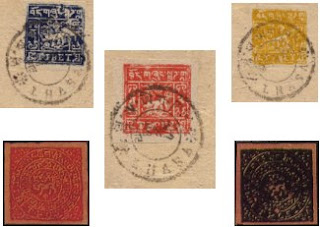 Post Stamps issued by Tibet

Passport issued by independent Tibet

Tibetan Banknote
[see Footnotes: g]
The Tibetan Passports were recognized by other Nations.
This specimen bears the stamps of many countries:
France, India, Italy, United Kingdom, United States, Switzerland
Before the Invasion there was to be found in Tibet:
• No Chinese judge
• No Chinese law
• No Chinese policemen
• No Chinese newspaper
• No Chinese soldier
• No Chinese writ which ran in Tibet
• Not even a Chinese Government Representative!
Tibet, just like every other Sovereign Nation, conducted its own Affairs and had the Status of a Sovereign, Independent Nation. 
Mao declared, on having to cross Tibetan Territory on his “Long March” and being looked after and fed by local Tibetan People:
"This is our only Foreign Debt, and some day we must repay the Tibetans for their Hospitality and the Provisions we were obliged to take from them".
In 1950 the Chinese Communist Government negotiated with the Tibetans as an independent Nation and ‘offered' the 17 Point Agreement, alas at the point of the gun, as at the same time the Chinese Communist forces had already invaded Tibet.
While occupying vast tracts of Tibet, the Han Chinese Communists coerced, by threat of (more) violence, the signing of the “17 Point Agreement”, which was rescinded later.

Propaganda Photograph of signing.
This “17 Point Agreement” clearly has no legal basis in International Law.
It was imposed under duress, by unequal partners, the Deputation had no authority to sign, which was clearly conveyed to the Chinese by the Tibetan Delegation, and the Seal was forged by the Chinese.
Unable to declare their non-acceptance of the forced Agreement while under such forbidding occupation, the Dalai Lama finally repudiated this ignominious treaty on the 20th June 1959, once in freedom in India.
The Chinese Communists issued many pronouncements to the effect that they would never annex Tibet:
Mao Zedong ‘promised’ the Dalai Lama that the Chinese will leave Tibet once 'liberation' is complete.
In 1950, before full scale Invasion, China "assured" India that China had no intention of ‘incorporating’ Tibet into China by Force or Otherwise!
In 1956, Chou En-lai assured Nehru that China did not consider Tibet as a Province of China, but as an Autonomous Region.
The Geneva-based International Commission of Jurists, in its 1960 report, examined the legal status of the Tibetan Government and Nation:
“The view of the Committee is that Tibet was, at the very least, a de facto independent State when the Agreement on Peaceful Measures in Tibet was signed on the 23 May 1951, and the repudiation of this Agreement by the Tibetan Government on the 20 June 1959 was found to be fully justified.
In 1950, there was a people and a territory, and a government which functioned in that territory, conducting its own domestic affairs free from any outside authority. From 1913-1950 all foreign relations of Tibet were conducted exclusively by the Government of Tibet and countries with whom Tibet had practice as an independent State”.
The primary precept of International Law is the preservation and integrity of Sovereign Nationhood.
Therefore the existence of Sovereign Nationhood cannot be repudiated or invalidated by extraneous influences or events which may befall a nation.
The aggrieved nation always enjoys the presumption of continuation of independence and sovereignty.
The burden of proof is on the aggressor, the aggrieved Nation is not required to tender proof of its continued sovereignty.
In the case of Tibet, China clearly is bereft of any credible 'proof' to sovereignty over the Tibetan Nation.
International Law holds that recognition of a Nation’s Sovereignty can occur either by Explicit, or Implicit acts, including such as negotiations, treaties, and diplomatic relations.
In fact, the Tibetan nation has been explicitly recognized by many countries and enjoyed diplomatic relations with most countries prior to the invasion by the Han Chinese Communists:

• El Salvador formally requested that China's aggression against Tibet be placed on the agenda of the U.N. General Assembly.
• During the four U.N. General Assembly debates on Tibet in 1959, 1960, 1961, and 1965, many countries including the Philippines, Ireland, Thailand, United States, Nicaragua explicitly stated that Tibet was an independent country, illegally occupied by China.
• Irish Representative to the UN, Frank Aiken, stated:
"For thousands of years, or for a couple of thousand years at any rate, (Tibet) was as free and as fully in control of its own affairs as any nation in this Assembly, and a thousand times more free to look after its own affairs than many of the nations here. "
• The Thai Ambassador to the UN stated: "The majority of states refute the contention that Tibet is part of China.”
• "Aggression" and "Invasion" were widely used terms to describe the Chinese occupation of Tibet during these debates.
• The U.N. passed three resolutions in 1959, 1961, and 1965 regarding Tibet, stating that Tibetans are deprived of their inalienable rights to self-determination through the illegal occupation by China.
• The Nepalese government in its 1949 application to the UN for membership listed Tibet as an independent country with which Nepal maintained full diplomatic relations. The Nepalese diplomatic mission in Lhasa maintained full embassy status, staffed with an Ambassador right up until 1962.
[see Footnotes: h]
• Mongolia explicitly recognized Tibet's sovereignty by signing the 1913 Treaty with Tibet called the ‘Treaty of Friendship and Alliance’, signed by both Nations.
• In a 1943 note to the U.S. State Department, the British embassy in Washington explicitly stated that, "Tibet is a separate country in full enjoyment of local autonomy, entitled to exchange diplomatic representatives with other powers."
• In December 1950 the U.S. State Department declared the following in a public statement:
“The United States, which was one of the early supporters of the principle of self- determination of peoples, believes that the Tibetan people have the same inherent right as any other to have the determining voice in its political destiny. The United States Government recognizes the de facto autonomy that Tibet has exercised since the fall of the Manchu Dynasty, and particularly since the Simla Conference. "

• The CCP themselves, in a draft constitution drawn up in 1931, stated the following: "National minorities may either join the Union of Chinese Soviets or secede from it."
This implicitly included the Tibetan Nation.
• Prior to the invasion, Tibet independently maintained diplomatic, economic, and cultural relations with various countries such as Mongolia, Nepal, Sikkim, British India, China, Russia and Japan.
• Britain, Nepal, Bhutan, India, and even China before their expulsion, maintained diplomatic missions in Lhasa. The Tibetan Foreign Office conducted talks with President Franklin D. Roosevelt when he sent representatives to Lhasa to discuss the allied war effort against Japan during World War II.
• China's own last Head of Mission in Lhasa, Shen Tsung-Lien, wrote after leaving the country in 1948, "Since 1911 Lhasa (i.e. the Tibetan Government in Lhasa) has to all practical purposes enjoyed full independence".

[see Footnotes: i]
China’s untenable claim over Tibet is based solely on the influence which the Mongols in the thirteenth, and Manchu emperors in the eighteenth century, with varying degrees, exercised over Tibet.
In the case of the Mongol Yuan Dynasty the claim is nonsensical, as already examined the two nations were separate entities under Mongol rule, separately administered and treated entirely differently.
And in the case of the Manchus the degree of influence at best was very limited, did not extend to governance of Tibet, and was so sporadic and short lived, that it is entirely meaningless as a claim to suzerainty over, let alone “ownership” of Tibet.
In any case, since Tibet enjoyed unfettered Sovereignty and independent Nationhood for so many decades prior to the invasion, de facto sovereignty is well established in International Law and therefore requires no explicit recognition by any other country, and distant historic events become irrelevant.
As members in the UN debates have clearly noted: Tibet has enjoyed and displayed unfettered independence to a much larger degree than most countries presently in the UN, and perhaps more so than “China” which always was at best a very fluid concept over the millennia and was ruled by foreign administrations for centuries.
If China's methodology were to be applied universally, most countries would have a claim over their neighbours, but more importantly, Tibet would have an equal claim to "ownership" over 'China'.
Presenting the facts in any other light is not only untenable, but is evidently in conflict with all the accepted historical data and International Law!

______________________
History is written by the Victor -
But the Truth will never die.
__________________________________
Conclusion:
In 1949 there were a unique, cohesive people, which inhabited their ancestral territory for millennia.
A fully functional, sovereign Government and Nation, which enjoyed unfettered independence for four decades, domestically, and on the International stage.
A sovereign nation, which refused to be allied to any other state, and was fiercely defending this right to stay neutral and independent.
A people, which refused to be subjugated by a foreign invader and rebelled against this occupier against all odds.
International Law is, beyond any reasonable doubt, on the side of the Tibetans; only the callous obduracy of the Chinese occupiers, and pusillanimous international expediency towards a powerful nation, economically and militarily, is preventing a fair solution to be implemented for the Tibetan populace - namely Independence.
Who after all have the inalienable right to self determination, enshrined in Law and signed by the occupying nation.
Today, Tibetans are deeply unhappy and live in a state of constant fear and terror, so much so that they risk their lives, lengthy prison sentences, torture and abuse, and very often their lives for just carrying a photo of the Dalai Lama, to protest the degradation and atrocities endured, or to defy the callous Chinese rule.
And every year several thousand flee their homeland to India in an attempt to escape a life of oppression and denigration and risk being shot like dogs by the Chinese border guards, if they are spotted on their way to Freedom.
A claim to self-determination by the Tibetan people clearly is unquestionably valid on all counts under International Law:
• As a distinct people
• As a people being ruled by an illegitimate government
• And continuing to be an occupied, independent, sovereign nation after having exercised unfettered sovereignty for at least the four decades prior to the invasion by Chinese forces, but effectively for two millennia of its proud existence as an Nation!
[see Footnotes: j]
________________________________________________
Footnotes:
■ a) The PRC under the CCP has systematically reinterpreted and rewritten Tibetan history, to the extent that most of the notable scholars on the subject are exasperated at the scope of distortion and fabricated untruths.
Every aspect of Tibetan history is used as a propaganda tool:
• To justify the occupation and annexation of Tibet
• To ‘prove’ Chinese “ownership” of Tibet.
• To portray Tibetan history as feudal, backward and barbaric who now should be grateful at being ‘liberated’.
• And to generally denigrate the Tibetans as a lesser people than the Han Chinese, who now ‘benefit’ from the economic development brought by all the Han Chinese settlers.
• Even their version of historic accounts employ this theme, and for instance portray Princess Wen Cheng as the source of all that’s civilized and notable about Tibetan culture and achievements.
Following is an inscription of an earlier Pillar, the “Pillar of the Zhöl Quarter”, relating events prior to 763, and giving some context to the 823 treaty:
“…..the two great commanders were ordered to carry war to Keng-shi. On the bank by the ford of Chi-hu Chir a great battle was fought with the Chinese. Tibet put them to flight …. many Chinese were killed. The Chinese King Kwang Peng Wan also fled from the fort to Sshem-ci’u…. Keng-shi was captured….”
The pillar inscriptions were deliberately damaged by the Chinese, with the missing words reinterpreted and the meaning of the text materially altered to suit their purpose.
However existing photographs and historical accounts of the inscriptions still relate the true context and meaning.
■ b) Chinese ‘historians’ today claim that the Mongolian Yuan Dynasty was in fact “Chinese” and hence the Ming emperors ‘inherited’ sovereignty over Tibet from this era, (the Mongols) but no other respected scholar can come to this conclusion, and is invariably described as 'nonsensical and absurd'.
This disregards that the Emperors were Mongols and the administration was Mongol, with no Chinese appointed to government positions, and most importantly, the Manchus were eventually overthrown and driven out.
■ c) The Chinese today claim to have installed the Dalai Lama lineage and bestowed them with their title and powers.
In 1577 the Mongol prince Altan Khan, on advice of his nephew, invited the famed Sonam Gyatso, head of the Gelupga, or Yellow Hat School, to visit him, and to impart his renowned and celebrated teachings to him.
The two met in June the following year, and as was customary, the two sovereigns exchanged honorific titles. And in doing so Altan translated the Tibetan word Gyatso, meaning “oceanic virtue”, into the equivalent Mongolian word “Dalai”, meaning ocean.
The Tibetan word Lama was always reserved for reincarnations of important Buddhist teachers, or Tulkus, and the first two “Dalai Lamas” were in fact never called such, but known as Gedun Drupa and Gedun Gyatso respectively.
This honorific title ‘Dalai Lama’ was then retrospectively and posthumously applied to the previous two Gyatso Lamas and so they became the first and second, and Sonam Gyatso the third ‘Dalai Lama’.
However, Altan merely translated the existing Tibetan title, Gyatso, into Mongolian, and to this day every Dalai Lama since the second, still bears the name Gyatso, as in the XIVth Tenzin Gyatso, so even the Mongolian “Dalai” does not amount to any granting of title, or honorific thereof, but was merely a Mongolian translation of the existing Tibetan title.
It was Gushri Khan, ruler of the Qshot Mongol tribe, who defeated the rivals of the Dalai Lama faction, and the ‘Great Fifth’ Dalai Lama, Ngawang Lobsan Gyatso 1617-1682, was enthroned in 1642, who had already been recognized as the incarnation of the previous Dalai Lama.
He ruled supreme over a unified Tibet, with the Mongols subordinate to him.
■ d) The Manchu Emperor’s ulterior motives were to curry favour with the influential Tibetans, and also to indirectly assuage the potential threat the Mongols posed. The Tibetans maintained a very close and mutual relationship with the Mongols, who still proved to be a feared military power, potentially threatening the Manchu empire.
■ e) In fact, that the ‘29 point decree’ amounted to nothing more than well intentioned suggestions under the Cho-Yon agreement is clearly evident in the Envoy General Fu K'ang-an’s statement to the Eighth Dalai Lama on presenting the paper:
"The Emperor issued detailed instructions to me, the Great General, to discuss all the points, one by one, in great length.
This demonstrates the Emperor's concern that Tibetans come to no harm and that their welfare be ensured in perpetuity. There is no doubt that the Dalai Lama, acknowledging his gratitude to the Emperor, will accept these suggestions once all the points are discussed and agreed upon. However, if the Tibetans insist on clinging to their age-old habits, the Emperor will withdraw the Ambans and the garrison after the troops are pulled out.
Moreover, if similar incidents occur in the future, the Emperor will have nothing to do with them. The Tibetans may, therefore, decide for themselves as to what is in their favour and what is not or what is heavy and what is light, and make a choice on their own".
This clearly demonstrates that:
• The 29 point edict was nothing more than nonbinding suggestions,
• The relationship between the Manchu Emperor and the Tibetans was not one of overlord and subordinate, but rather one of two nations on equal footing, associated by an Agreement, which, at the time, vexed the Emperor after the Manchus having to comply four times under the terms of the Cho-Yon Agreement with requests for assistance.(1720, 1728, 1751, 1792)
• The Amban, envoys of the Emperor’s court, had no say in the running of the Tibetan Governments affairs, and were merely Ambassadors to a sovereign Nation.
And to illustrate these points further:
The Amban Yu Tai related in 1903 to Mortimer Durand, the then Foreign Secretary of the Government of India that he were “only a guest in Lhasa, not a master” and he “could not put aside the real masters”, and as such he had “no force to speak of”.
The Tibetan Government paid only scant regard to this 29 point paper and electively followed the advice where it suited them, and disregarded other points deemed unsuitable for running Tibetan affairs.
An apparently minor, but vital point is that none of the Ambans were Chinese, each one of them was a Manchu, a distinction which highlights the personal relationship the Manchu Emperors maintained with the Tibetans under the Cho-Yon Agreement.
Early in the seventeen hundreds, a resident Jesuit described the Dalai Lama's and his temporal Government's role as follows:
"The hierarchy which exists in Tibet is not secular but superior to all temporal and regular government. Head of all is the Grand Lama of Tibet.
He rules not only over religious, but over temporal matters, as he is really the absolute master of all Tibet."
■ f) The Qing Emperors in essence never exerted any meaningful, or even extended control over Tibet, and the relatively short period of very limited influence after 1792 amounted to a tiny fraction of the 2,000 year time span of proud, recorded Tibetan history!
However, regardless of the duration, extent or nature of any control a nation may have exerted over another in the distant past, such becomes irrelevant once the subordinate state achieves independence and sovereignty over its affairs.
In the case of Tibet, which enjoyed such unfettered Sovereignty for four decades, and by all intents and purposes for at least two millennia prior, safe the interlude of the Mongol Empire where Tibet pledged allegiance, but governed itself and even became the Patron to the Mongol Empire, the question of past alliances is irrelevant.
This would be the case even if Tibet would have been to a degree subordinate to China, which was not the case.
The very limited degree of influence the Manchu Empire managed to exert falls a very long way short of control, suzerainty or sovereignty, as China today claims.
If this principle were to be applied, the law of the jungle would indeed prevail and just about every state could lodge claims over every other.
The Buddhist Dalai Lamas did not maintain strong armies for defence, unlike their predecessors of the powerful and feared Tibetan Kingdom, but relied on the Cho-Yon agreement for defence of their country.
This pacifist approach was to become a point of exploitation by the Manchus who sought to increase their influence over Tibet, but only marginally managed to exert some very limited degree of influence.
However the Tibetans never viewed the affairs between their states in this light, and always fiercely maintained their independence.
The intent of an aggressor, the Manchus in this case, could never legitimize any control they may have managed to exert over another, sovereign state.
■ g) Tibet commenced the issue of its own currency in coins, the Tamka, from 1792, which was based on the Nepalese currency as its model.
Paper Banknotes and Postage Stamps were issued from 1890 and both currencies were in use until 1950 after the invasion and occupation by China.
The coins and Banknotes bore the Government Seal of a Lion and the Date of Issue.
In 1947-8 the Tibetan Government sent a Trade Delegation to India, UK, US and China.
They were issued with official Tibetan Government Passports and travel documents which were recognized by every Government of all the countries visited. The UK issued them with diplomatic visas.
■ h) The Purposes of the United Nations are:
Article 1.2.
To develop friendly relations among nations based on respect for the principle of equal rights and self-determination of peoples, and to take other appropriate measures to strengthen universal peace;
In essence every member to the UN has singed up to the principle of People's right to Self-Determination, including China.
The “International Covenant on Civil and Political Rights” states the following in Part I, Article 1:
1. All peoples have the right of self-determination. By virtue of that right they freely determine their political status and freely pursue their economic, social and cultural development.
3. The States Parties to the present Covenant, including those having responsibility for the administration of Non-Self-Governing and Trust Territories, shall promote the realization of the right of self-determination, and shall respect that right, in conformity with the provisions of the Charter of the United Nations.
China is a signatory to this treaty and therefore bound by its covenants.
The UNESCO meeting of Experts on Further Study of the Rights of Peoples held in Paris in February 1990 stated the following conclusion:
"A People for the rights of peoples in International Law, including the right to self determination, has the following characteristics:
1. A group of individual human beings who enjoy some of all of the following common features:
a) A common historical tradition;
b) Racial or ethnic homogeneity;
c) Cultural homogeneity;
d) Linguistic unity;
e) Religious or ideological affinity;
f) Territorial connection;
g) Common economic life;
2. The group must be of a certain number who not be large (e.g. the people of micro states) but must be more than a mere association of individuals within a State;
3. The group as a whole must have the will to be identified as a people or the consciousness of being a people - allowing that groups or some members of such groups, though sharing the foregoing characteristics, nay not have the will or consciousness;
4. Possibly the group must have institutions or other means of expressing its common characteristics and will for identity.
The Experts concluded that the Tibetan People satisfied these requirements as a distinct and homogenous people for International Law purposes.
It was also noted that even the PRC explicitly treated the Tibetans as a distinct People, in law, under the Constitution, and in establishing the TAR.
The Tibetan people however are denied the right to self determination they are entitled to under International Law
UN Resolutions 1353, 1723 and 2079 recognized the Tibetan People as a distinct people under International Law, and Resolution 1723 and 2079 explicitly express the right of the Tibetan People to Self Determination.
■ i) China was enthusiastically in favour of Timor Leste achieving independence and argued that “the choice of the Timorese people should be respected”.
A fundamental right, enshrined in the UN Charter and the ‘Covenant on Civil and Political Rights’, both of which China is a signatory to, but which the Tibetan people are denied by their occupiers.
■ j) China claims that the right to self-determination was never designed to facilitate secession, and claims that it can not be used to undermine its territorial integrity. A claim it clearly only wishes to apply to its 'own territory', but not for others like Indonesia in the case of Timor Leste, or Serbia for Kosovo, who both rightfully gained their independence, to which China lent its explicit support.
Firstly, as already examined, the PRC can not demonstrate that Tibet ever was an integral part of what today is considered as “China”.
Secondly however, a government has to be the legitimate representative of a people to use this claim, but even then, the Tibetan people, being a distinct and cohesive race and having occupied their ancestral lands for millennia, still always have the right to self-determination.
An illegitimate government can never raise a claim of territorial integrity.
A government who engages in conduct contrary to International Law, Treaties and Conventions, which does not originate from the will of the people it governs, and does not abide by universally enshrined Human Rights and Freedoms, is not the legitimate government of these people.
China clearly is not the legitimate government of the Tibetan people, as it has, and continues unabated, to grossly violate all these conventions, treaties and covenants China has signed up to and is legally bound by.
A claim to self-determination by the Tibetan people clearly is unquestionably valid on all counts under International Law:
• As a distinct people
• As a people being ruled by an illegitimate government
• And continuing to be an occupied, independent, sovereign nation after having exercised unfettered sovereignty for at least the four decades prior to the invasion by Chinese forces, but effectively for two millennia.
_______________________
Bibliography:
Tibetan Paintings: Pratapaditya Pal
The Circle of Bliss: John Huntington, Dina Bangdel, Robert Thurman
China's Tibet Policy: Dawa Norbu
Early Ming policy toward Tibet: Elliot Sperling
Tibet: Robert McCorquodale, Nicholas Orosz
Chinese Sculpture: Angela Falco Howard, Li Song, Wu Hung, Yang Hong
Secret Visions of the Fifth Dalai Lama: Samten Gyaltsen Karmay
High Frontiers: Kenneth Bauer
Tibetans in Yüan China: Herbert Franke
History as Propaganda: John Powers
Empire of Emptiness: Patricia Ann Berger
The Cambridge History of China: Denis Twitchett, John King Fairbank, Frederick W. Mote
United Nations
Office of the United Nations High Commissioner for Human Rights
Center For World Indigenous Studies
Tibet and Nationalist China’s Frontier
BBC
Die Weltwoche
NZZ
Xinhua


 Death by a Thousand Cuts, a uniquely Han form of torture!
 The Chinese Finger Presses now blamed on the Tibetans by the Han CCP in their exhibitions
 A representative picture of Chinese execution of Tibetans by beheading
 Ling Ch'ih, a torture widely practiced by the Han Chinese in Tibet







 Posts


